
Unleashing Affordable Energy Dominance with Efficiency
Energy policies change with administrations, global events, and economic tolerance.
Today the focus is on “Energy Dominance”, “Energy Independence”, and “Energy Security”. Three goal descriptors that are shaping policy.
Despite our personal experiences, opinions and politics we should be able to see that some new policies are moving the U.S. toward these goals while others are not. Some policies will likely make it harder or at least more expensive to get there. Strange since “Affordability” is another stated goal of the administration. So how can the goal of “Energy Dominance” be reached affordably? If you pay utility bills you probably care about the answer. I know I do.
Our current administration is not the first to have energy dominance, independence or affordability goals. We’ve seen these goals before. How these goals were tackled however has differed over the years.
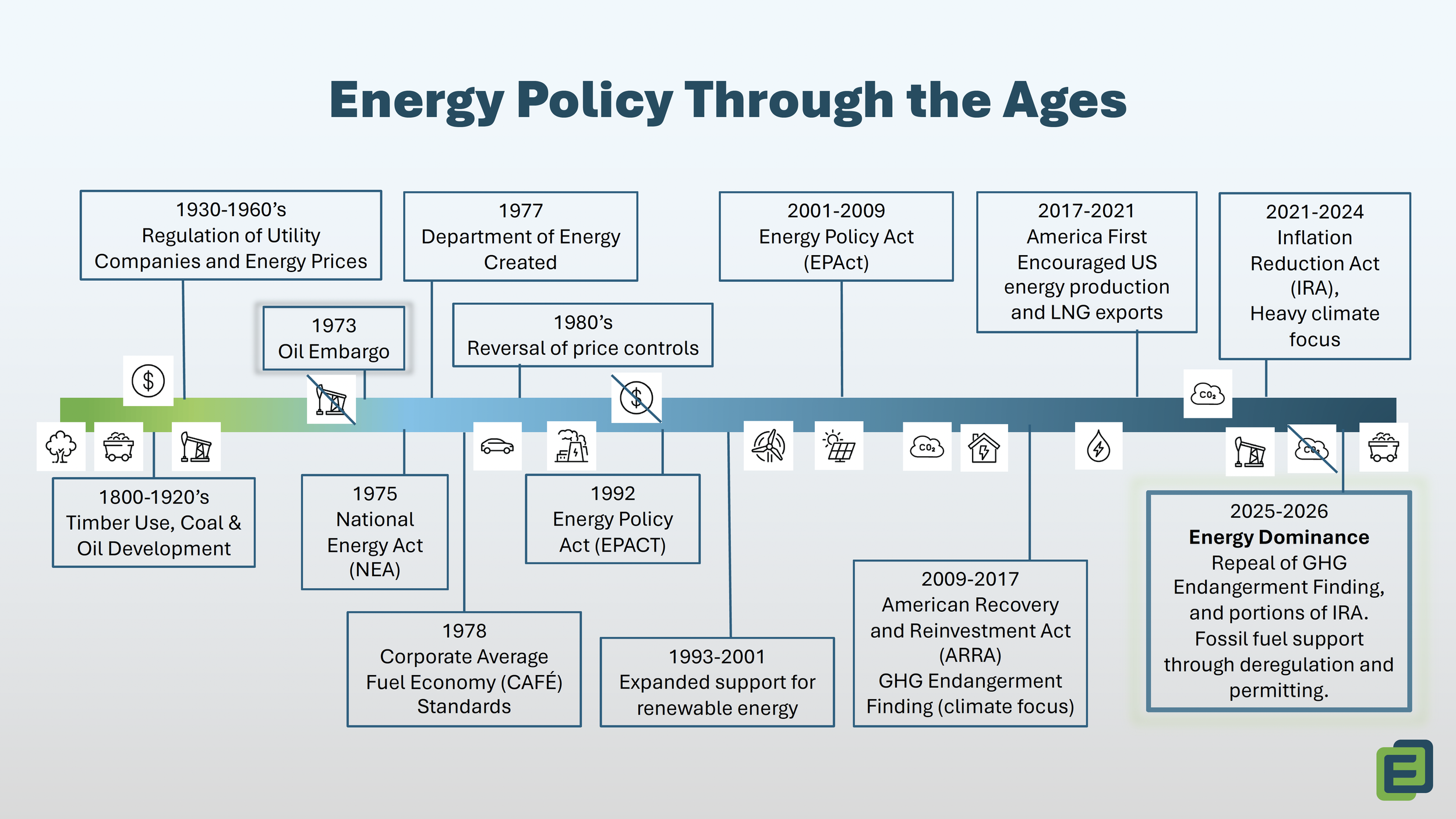
We’ve had energy goals and policies in place for a long time. But events like the oil embargo in 1973, and various other global conflicts have often caused shifts in our energy policies.
We have even seen flip flopping (price controls vs. no price controls, drill baby drill to stop the drilling and back to drill baby drill again).
One thing is clear, energy is power . . . politically and literally. Energy often dictates a country’s GDP capacity, its security, its freedom, and its global influence.
The U.S. produces a lot of energy. In 2024 we were #2 dwarfed only by China.[1]
BUT . . . we also consume a lot of energy. We consume it for basic needs like drinking water, wastewater treatment. For manufacturing, farming. And in our homes to cook, heat, cool, and charge our phones. And once again our consumption is only dwarfed by that of China.
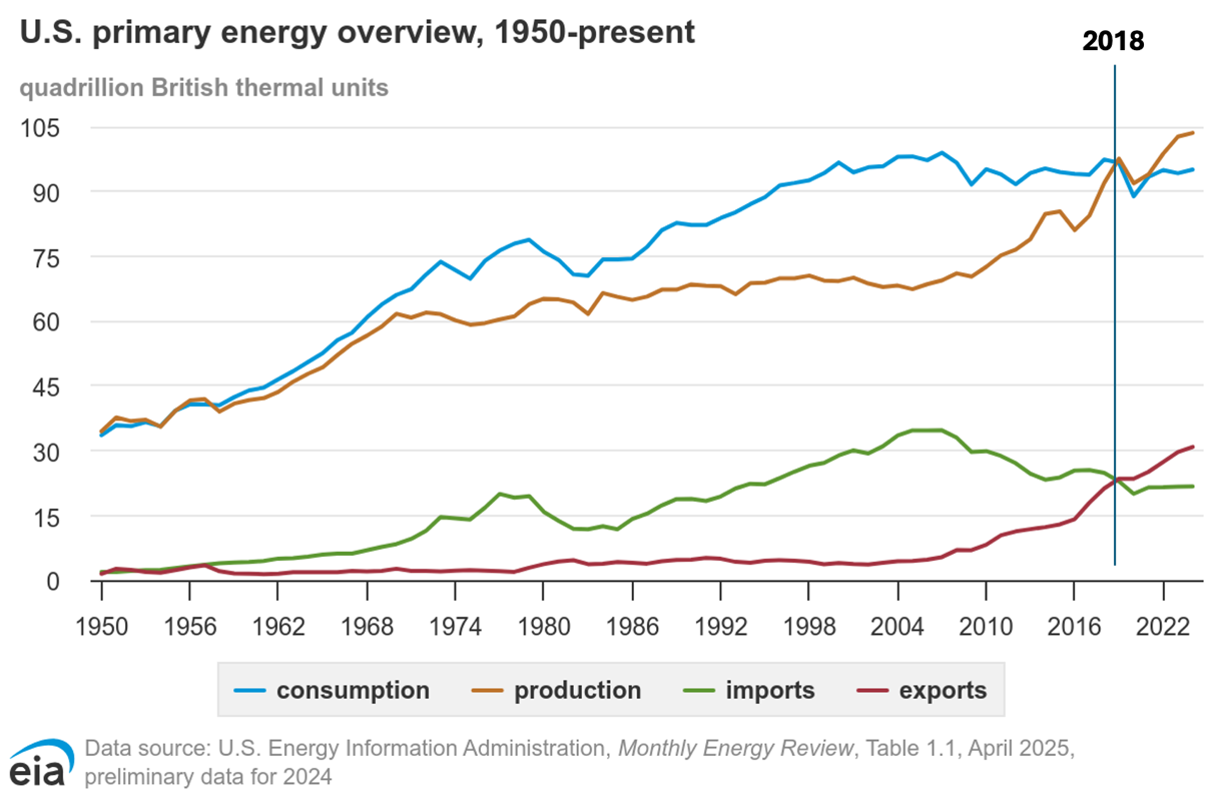
The U.S. is only recently showing signs of moving towards energy independence. As of 2018 we do produce more energy than we consume. We also started exporting more than we import.
But we still import energy.
I don’t pretend to understand all the reasons we currently import so much energy, but I do know that we are “refinery mismatched” meaning that we do not have sufficient infrastructure to refine domestic “sweet crude”. Our ability to refine heavier “sour crude” is much higher making it less expensive. We also lack other system and infrastructure like pipelines that could improve the use of our own resources vs. foreign resources.
Building new or retrofitting existing refineries to refine domestic crude oil would be expensive making it much more cost effective to import and refine heavier foreign crude oil.[2]
If we could solve that dilemma we’d take care of a large portion of our current energy dependence.
Crude oil dominates our energy imports. In 2024 it accounted for 67% of our imported energy.[3] It is also one of the more volatile markets. The U.S. is significantly affected by price spikes, many of which we could not predict or control.
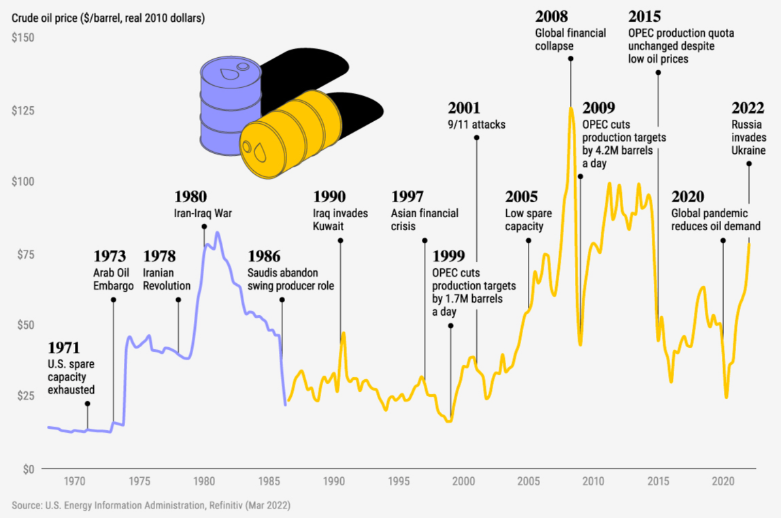
We’ve been forced to be reactive.
And yes, there have been proactive policy attempts to mitigate our dependency on foreign oil, but our memories are short, our energy appetite is big, and solar is sexy.
So, our struggles continue.
As we seek to meet our goals there is a nuance to energy independence and energy dominance that we shouldn’t miss.
To be energy independent we need to produce enough domestic energy and energy products to meet our needs.
To be energy dominant we need to produce more than enough domestic energy and energy products to meet our needs and to export excess energy to increase our security and global influence.
How do we get there? This is over simplified but . . .
1. Increase US energy production
2. Increase US Critical Mineral and Energy Product production
3. Increase Energy Efficiency
#1 Increase Energy Production . . . As previously mentioned there has been a ramp up of domestic energy production even to the point of exceeding consumption and we do export energy . . . BUT we are yet not energy independent. We still rely on foreign energy sources.
We have a long way to go, especially if we are going to maintain our trajectory in the face of growing data center and domestic manufacturing.
We need to increase our refining capabilities, particularly our sweet crude refining capabilities. We need to embark on energy exploration and innovation. We also need to modernize or build new pipelines, nuclear generation facilities, hydropower generation facilities, utility scale solar geothermal and energy storage systems, etc.
Unfortunately, all these things are very pricey $$$. Often passed along to all of us in the form of increased taxes, utility rates, and utility delivery charges.
#2 Increase U.S. sourced Critical Minerals and Energy Products . . . this is an even tougher lift . . . Our geology has us constrained. In many cases we just don’t have the domestic natural resources available to us.
In some cases, we source 100% of an energy dependent critical mineral from foreign sources. This leaves us in a very vulnerable position. Below is just a snapshot of some of the critical minerals we depend on for energy and their primary sourcing.
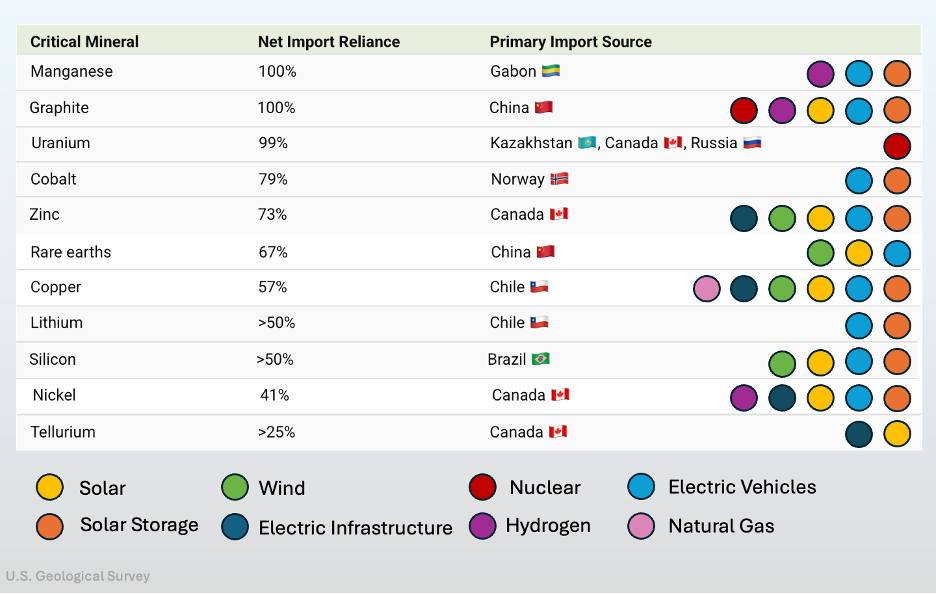
In some cases, we can prioritize friendlier sources or increase domestic mining and refining. But like increasing domestic energy production, new infrastructure is costly and is not an overnight solution.
I think it is great that we are working on these things. It is important and depending on foreign sources comes with a VERY HIGH price tag. That price is not in our control and could cost us American lives and freedom not just dollars.
#3 Increase Energy Efficiency . . . The only way we have a shot at becoming energy independent or dominant in way that doesn’t hurt our economy, increase taxes and increase utility costs is to make energy efficiency a major part of the policy plan.
With the other U.S. goals to lead in AI and to reshore our advanced manufacturing, it is almost certain that our energy needs are going to grow significantly.
So, using energy efficiently may not result in a reduction in overall U.S. energy consumption but it will lead to increased energy productivity . . . and reduce the amount of energy we need to hit these goals.
Because if you haven’t heard . . .
“The cheapest energy is the energy you don’t use in the first place.“
This isn’t a new revelation. A new 2026 CREO study,[4] Affordability Is All You Need, Meeting New Peak Capacity and the Next Era of U.S. Grid Investment, once again agreed with this truth.
The report compares energy investment strategies for achieving increase peak energy capacity. It shows that efficiency and demand flexibility provide the most benefit at the lowest cost. See Figure 6 from the report below.
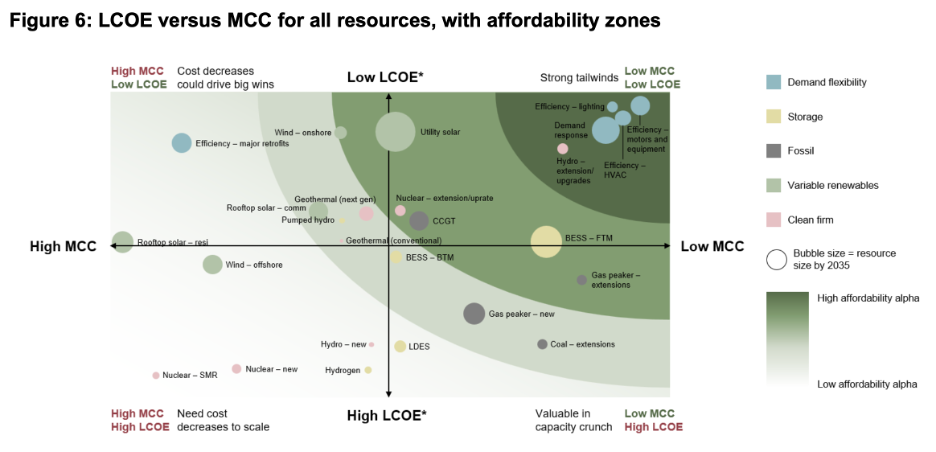
There is a caveat. If you don’t implement efficiency measures when a building is constructed it is more costly later. See the blue dot (lighter green band) for major retrofits compared to the blue dots for other efficiency measures (dark green band). That is why building energy codes are so important. Building energy codes represent the least efficient home or building that can be legally built . . . and yet these codes are far behind market capabilities and are often weakened when adopted by states and local jurisdictions due to pressures from homebuilder special interest organizations.
In 2024 our buildings accounted for 28% of the U.S. energy consumption.[5] This is also a sector that has a lot of wasted energy and a lot of available solutions.
This report compares 3 energy investment scenarios. One looks a lot better than the others.
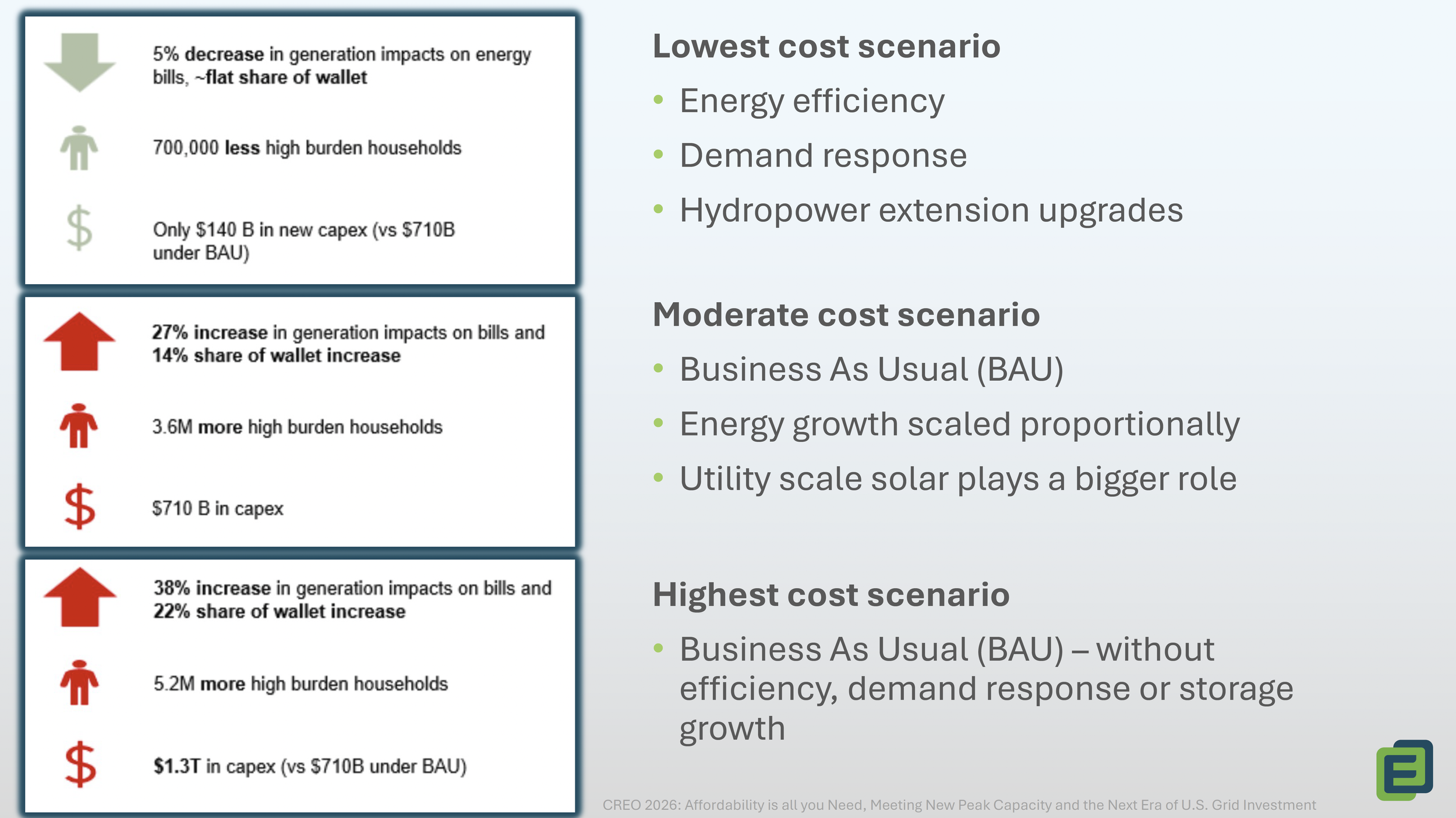
The Business As Usual (BAU), Moderate Cost Scenario is our more likely future unless there is a shift in policy. The lowest cost scenario not only requires the expenditure of the least amount of capital it also protects the public and broader economy.
Efficiency, especially buildingenvelope efficiency in the form of insulation and air sealing quietly sits in the background doing its job 24/7. It saves energy and dollars. We need a lot more of THAT.
We need to continue to encourage our policymakers to do the right thing. Prioritize energy efficiency for a more “affordable” energy future . . . and by all means do not reduce it!
The Energy Efficient Codes Coalition (EECC) supports energy efficiency policy and could use your help. Sign up to be an Ally today at www.energyefficientcodes.org
All the best,
Amy Schmidt
Executive Director
Energy Efficient Codes Coalition
[1]https://www.eia.gov/international/rankings/world?pa=12&u=0&f=A&v=none&y=01%2F01%2F2024
[2]https://www.afpm.org/newsroom/blog/how-much-oil-does-united-states-import-and-why
[3]https://www.eia.gov/todayinenergy/detail.php?id=65664#:~:text=U.S.%20total%20energy%20imports%20were,imports%20from%20Canada%20nearly%20doubled.
[4]www.creosyndicate.org/wp-content/uploads/2026/01/2026_Energy_Affordability.pdf
[5]www.eia.gov/energyexplained/us-energy-gacts/images/consumption-by-source-sector.pdf