

Buried on pages 45–47 of a 53-page bill are two small changes to North Carolina's energy code that could make new homes cost more to live in for as long as they stand.
Senate Bill 445 is an omnibus bill: many unrelated legislative changes bundled into one. Governor Josh Stein signed it on August 11, 2026. Much of it is good news for housing. It loosens restrictions on accessory dwelling units and on housing in commercial and industrial zones, along with a handful of other housing and non-housing rules.
But two provisions weaken how well new homes must be insulated. Lower construction costs for builders don’t necessarily translate to a lower sticker price for buyers, but cutting costs on energy efficiency improvements will result in higher utility bills every month after. (For more on that, see my previous post, Housing Affordability – The Sticker Price Doesn't Tell the Whole Story.)
PROBLEM #1: A CARVE-OUT FOR SPRAY FOAM
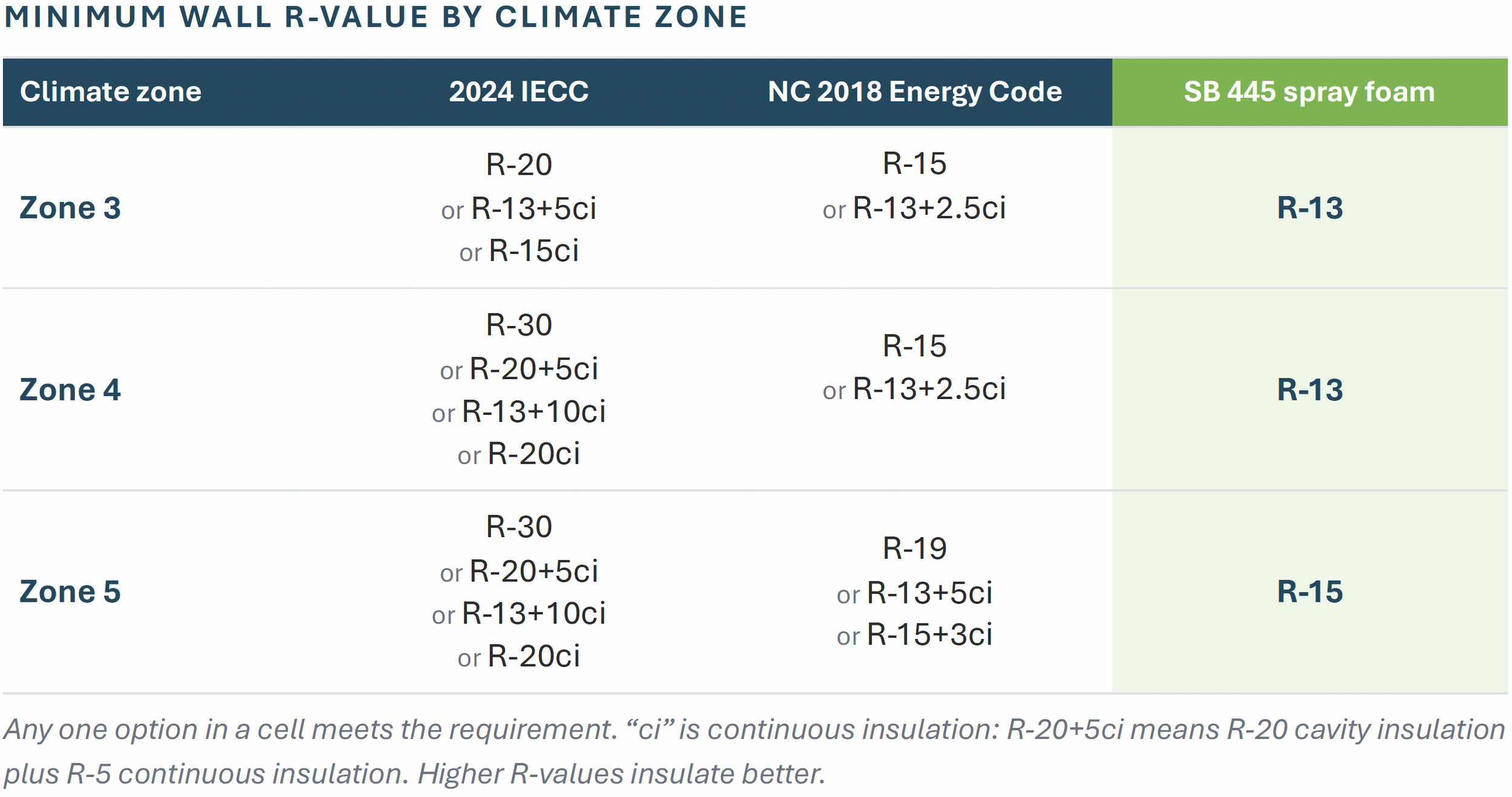
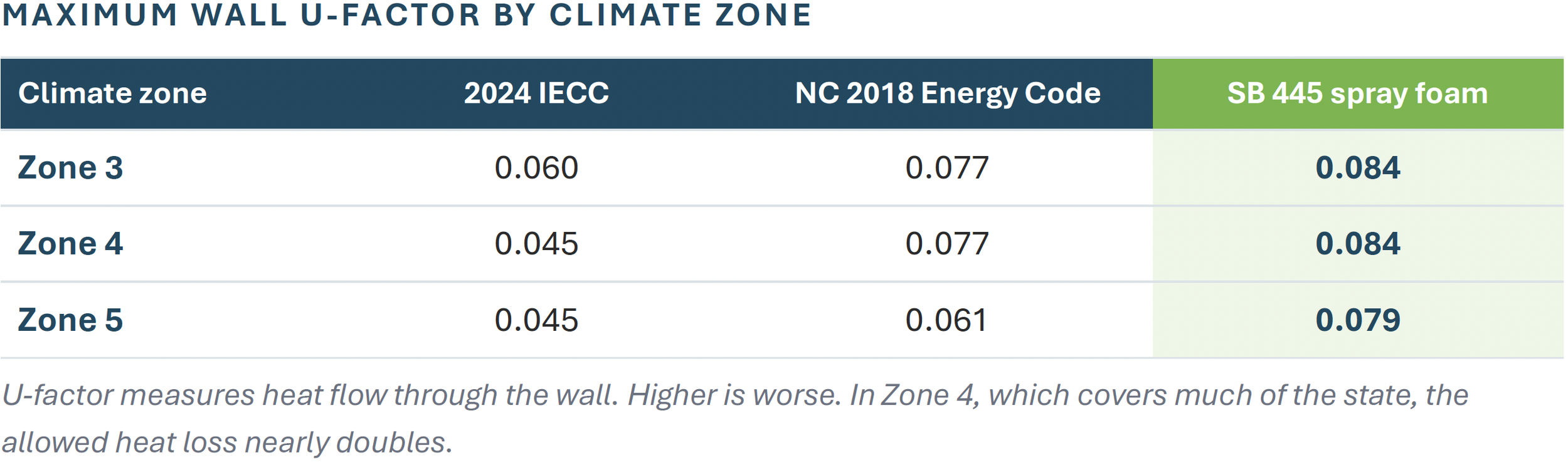
The bill creates a special, product-specific exception for spray foam insulation, described in the bill as “certain insulation in walls.” Homes that use it may install an insulation R-value up to 57% less than the national model energy code, which would then allow up to 86% more heat to pass through the wall. The main problem: SB 445 discourages the use of continuous insulation, which significantly reduces heat loss (or gain) through the wall framing members. While spray foam can provide effective cavity insulation and air sealing, it does not address thermal bridging through wall framing members and does not automatically ensure better air tightness. Continuous insulation reduces this heat loss and heat gain by providing an uninterrupted layer of insulation across the framing, improving the overall thermal performance of the wall assembly.
In exchange, homes using this alternative pathway must hit a tighter air leakage target: 3 air changes per hour (ACH50) when tested. That sounds like a fair trade, but achieving 3 ACH50 or lower is not unique to spray foam. Wall assemblies using other insulation materials can also meet or exceed this airtightness requirement. The result is a product-specific exception that reduces insulation requirements without demonstrating equivalent whole-wall thermal performance.
“Air sealing and insulation do different jobs. A tight house with under-insulated walls still loses heat through those walls, every hour of every day.”
PROBLEM #2: THE ERI PATH LOSES ITS SAFETY NET
The second change removes the minimum insulation and window (fenestration) requirements from the Energy Rating Index (ERI) compliance path.
The ERI is a performance-based option. The home is modeled under standard rules to produce an index score, and that score must not exceed a target. The code minimums the bill removes were there to protect homeowners from bad tradeoffs.
Trading one energy measure for another is fine in concept, but only if each measure is weighted by how long its savings last. The ERI doesn't do that today, which is why there are backstops. Without adequate weighting or backstops, one could trade away insulation for a shorter-lived measure like an Energy Star washer and dryer, or for solar panels.
Efficient appliances and cleaner energy have real value. But appliances wear out and get replaced, and panels age. Insulation sits in the walls and keeps working for the life of the building. Without the minimums, a homeowner can end up with a house that scores well on day one and underperforms for decades.
WHY IT HAPPENED AND HOW IT GOT THROUGH
What's the harm? Homeowners will pay more on every utility bill for the life of the under-insulated home. While using less insulation puts more money in builders’ pockets, there is little to no evidence that shows lower construction costs translate dollar-for-dollar into lower purchase prices. Legislation should not be used as a tool to market specific product types or trade first cost reductions for long term increased consumer costs.
How did it pass? Legislators are not building scientists with deep expertise in R-value, U-factor or ACH50. While supporters of the bill likely argued that the changes would not harm homeowners, slipping technical code changes into a large omnibus regulatory bill was intended to shield the changes from public debate. SB 445 demonstrates why technical changes to a state’s building code should be debated within the public and transparent code adoption processes led by the responsible state agency.
WHAT NORTH CAROLINA BUILDERS CAN DO
If you build in North Carolina and know better, the code is now a floor you can choose to rise above.
Call your legislator. Have a conversation and explain what these provisions actually do.
Educate yourself and clients. Help them make wise long-term decisions about their homes and their utility bills.
Build to leave a legacy. Provide your buyers with quality homes that meet modern standards for energy efficiency and leave a legacy of homes that keep performing long after the sale.
The Energy Efficient Codes Coalition (EECC) supports energy efficiency policy and could use your help. Sign up to be an Ally today at www.energyefficientcodes.org
All the best,
Amy Schmidt
Executive Director
Energy Efficient Codes Coalition